A.H. Almaas, the Logoi, and the Quantum View of Realization
Introduction
This piece is the first in a two-part series. It provides some important background around how Enneagram Parts Work developed and its spiritual context. We will look at how it is rooted in a deeply transformative field of consciousness, rather than being separated from a conscious connection with Spirit, which is also called our True Nature.
There are a myriad versions of the Enneagram going around nowadays, many of which have been uprooted from the mysterious, sacred ground of existence. The problem is that when the Enneagram is separated from an authentic and deep spirituality, it loses its power, its efficacy, and is unable to serve its true purpose in that disconnected state. It’s meant to serve the awakening of Spirit within us, as us, and actually living from this higher consciousness here and now, as we take food and breath on this beautiful earth.
To talk about about the larger field within which Enneagram Parts Work (EPW) resides, it would be best to begin by sharing some of my own experiences and to explain how the teachings of A.H. Almaas, the creator of the Diamond Approach, helped to frame and understand those experiences. This in turn led to an appreciation of his concepts of a spiritual teaching’s “logos”, and relatedly, the “quantum view of realization.” These luminous insights made it possible to formulate the initial EPW experiments. In particular, passages in Almaas’s books Inner Journey Home and The Alchemy of Freedom laid foundations for these explorations.
That said, let’s begin by turning towards some example experiences.
Personal Examples of Teaching-dependent Phenomena
As I explored different spiritual teachings, on a subconscious level, I related to my journey as a kind of grand quest. The Enneagram type 4 part of me, the central one, was seeking to answer the question “what is my path?” The 4 part of us instinctively knows that our true soul’s path is unique. It may overlap in territory with other people’s paths, but we can’t truly move forward if we imitate. We can’t “suck the marrow” out of our life journey if we aren’t being true to ourselves—that is, true to the unique way that Spirit wants to express through us.
Many of the different expressions of spiritual truth I made contact with felt like they had valuable pieces of a puzzle. Engaging with one would give me a missing piece, and another, rounded out the whole a bit more, and another, filled in a gap I hadn’t known existed.
Over time, I noticed that regardless of the specific teaching I was delving into at a particular time, two principles would remain consistent.
Teaching-dependent Insights: Practicing a spiritual teaching would reliably result in having insights about something I was experiencing in the same way it would be seen through the eyes of that teaching. Moments of insights are not experiences of merely thinking about something differently. They are “aha!” moments, like an epiphany or a recognition, which carry energetic, emotional, and sometimes somatic impact. I realized this: I could be dealing with the same kind of pattern or the same problem – for example, a type 4 pattern of judging myself – but the character of the insight arising in my field of consciousness would be determined by the teaching I was engaging with. If I was doing Zen, I’d have “Zen insights.” If I was on the Toltec path, I’d have “Toltec insights.” We’ll go over some detailed examples below.
Teaching-dependent Feelings and Experiences: Engaging with a teaching would make new feelings and new experiences arise that were particular to that path. The same things the teacher felt, I would begin to feel more of, and the other students likewise. The teaching caused these “new arisings” to occur, but they were always teaching-specific. If I would’ve gone to a different teaching and practiced it instead, different feelings and different experiences would arise. Zen, for example, felt grounded and benevolent. The Toltec path felt alive and empowering. I sampled many different paths, and this principle always applied.
To make these two principles less abstract, let’s look at some specific examples.
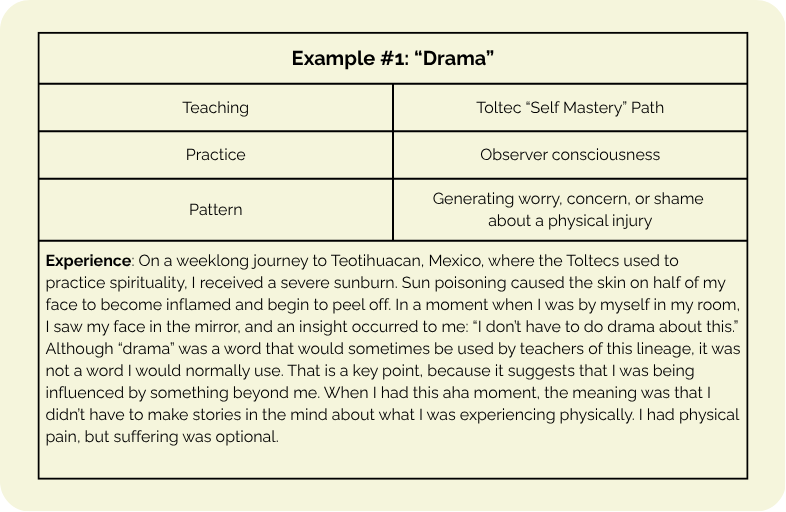
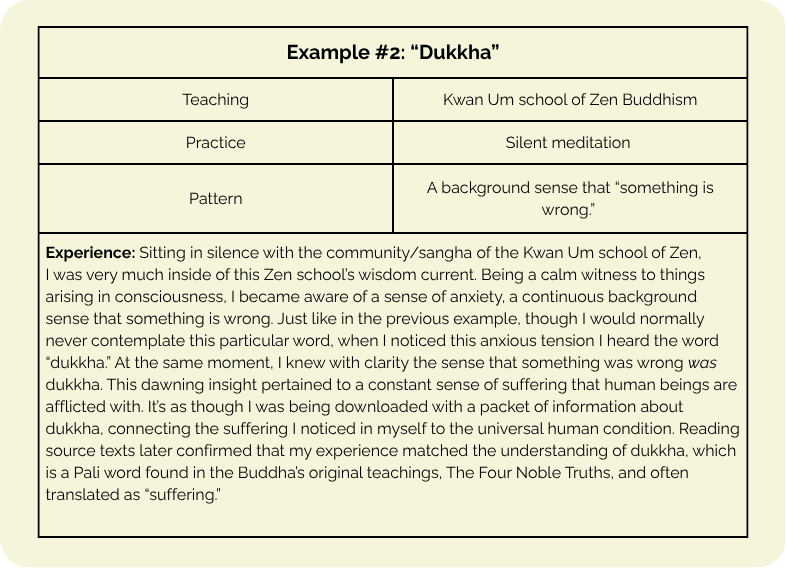
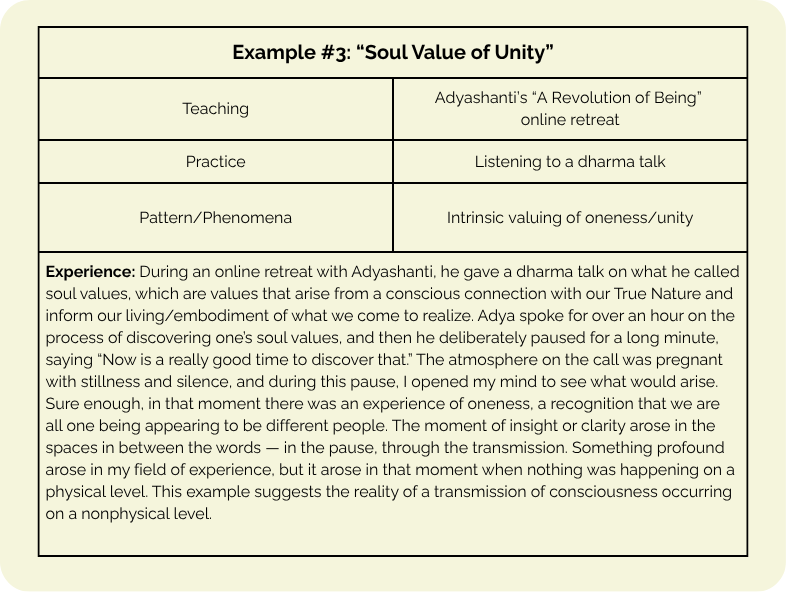
In sharing these examples, the point is not simply that engaging with different teachings will yield different insights. It is subtler and more profound than that. It’s not that I read books from a particular teaching, did their practices, and framed the experiences I had in terms of the information I learned in the books. Rather, the invisible container or context of the teaching affected me in such a way that the realizations arose within “me” but weren’t coming from me. They were somehow being created by the field of teaching itself.
Said another way, we can be influenced by teachings in such a way that we have insights and experiences we later verify with books and learning materials from the source teaching. Yet we can notice that, in the original event, the teaching caused something to arise in our field of experience without a physical causal agent. In the first example, I suddenly had the clarity that “I don’t have to do drama” without a teacher standing next to me, telling me that. This points to the idea that, somehow, the consciousness of the teaching is directly communicating with our own consciousness. It appears that we are receiving insights, feelings, and experiences from the teaching, from its field of consciousness, on a nonphysical level. How can we better understand this?
A.H. Almaas’s Insights into the Logoi of Spiritual Teachings
In his magnum opus, Inner Journey Home, A.H. Almaas describes how a genuine, revelatory spiritual teaching always has a logos behind it. A logos is not only a teaching’s logic and views of reality but a living current of wisdom, which the teaching is an expression of. Different teachings have different logoi. In the metaphysics of The Diamond Approach, the logoi are sub-patterns within The Logos, which is the grand pattern of all creation emanating from The Absolute. The Absolute is the subtlest dimension of reality and deepest ground of being.
When providing examples of how engaging with a teaching’s logos works, Almaas uses words like “field” and “context.” Although he doesn’t explicitly use the metaphor of water, he says it’s possible to be “immersed” in a logos and that a logos has a “flow.” He implies that there are degrees to which an individual can be steeped in the current of a logos, in contrast to the normal, default state of being outside of a logos. To make this less abstract, we might visualize a particular logos as a river of consciousness flowing out of the ocean of being. The important point, though, is that the logos of a teaching determines the experiences one has when engaging with the teaching. It is like the field of consciousness one is tapping into when one connects to a teaching in some way.
In other words, there is the content of the teachings themselves, including the practices, and then there is the living context in which they are all embedded—the logos.
Every teaching has a field of consciousness
Now I will begin to alternate between using Almaas’s language of “logos” and the term “field of consciousness” – or “field” for short – to convey essentially the same thing but without being entirely inside of The Diamond Approach.
When a person practices a spiritual teaching, just as Almaas says, they are at that moment engaging the entire logos of the teaching, whether they know it or not. When we are doing any teaching-based practice, we are engaging with – connecting to – the field of that teaching. On a nonphysical level, there’s actually a field of consciousness one is receiving insights and feelings from, and being influenced by, which gives rise to certain experiences.
To return to the previous three examples, it became clear to me in retrospect that in each case, the field of that particular teaching was acting on my consciousness. What is fascinating is how precise and specific that “acting on” or “influencing” really is. The field of consciousness would reveal my experience to me with the same, specific words that are spoken by the teachers of that lineage and found in the source materials, despite how unfamiliar I was with those words. These real moments serve as examples of how Almaas’s insights into the logoi of spiritual teachings can translate onto an experiential level.
Reality will be revealed to us differently depending on the teaching we are engaging with. Connecting to a different logos or field will yield a different revelation. Revelations tend to carry a deeply-felt sense of meaning, no matter where they come from, but the logos/field in which we experience them shades them with the colors of context.
Looking back at example two – “dukkha” – we can imagine that I would’ve been able to have a number of different insights into that background sense of “something is wrong,” especially if I had been focusing on that same pattern while being in different fields. I could’ve gone to a shamanic drum circle, brought my attention to the same pattern, and seen it through the eyes of a shamanic field. The revelation of insight would have had a different quality or flavor, as well as a different felt context around it—the living context of the shamanic field. In the field of Zen, as I said, the insight arrived with that specific word and had a felt connection to the palpable transmission of the Kwan Um school.
We can have an intuitive knowing that absolutely everything arises from the “One Mind,” as Zen Master Huang Po called it. That is a name for the unified field of consciousness. Everything is an extension of it. This recognition of unified reality is a throughline of all the great, authentic spiritual traditions.
At the same time, within the unified field, there are many sub-fields of consciousness, and every spiritual teaching has a field we can potentially connect to. Fields are alive; they are contactable contexts of energy and consciousness. It’s as if they contain the wisdom of past realizers. While it’s not the only factor, the field around a teaching does determine the insights, feelings, and experiences one has traveling along that path.
The Quantum View of Realization
Another lens through which Almaas understands spiritual teachings and their different revelations is something he calls the “quantum view of realization.” To get at what he’s saying, we first need to appreciate some findings from quantum physics. (I won’t be getting overly technical since I’m not a physicist).
The famous double-slit experiment demonstrated something surprising. A particle, such as an electron, can exist in a state of multiple possibilities until observed. This is known as the principle of quantum superposition. When electrons pass through a double-slit apparatus without their paths being observed, they produce an interference wave pattern. However, when their paths are observed, this interference pattern disappears. This property of wave-particle duality is related to the broader principle that the process of observing is intimately connected to what is being observed. Before observation, an electron’s quantum state is described as a wave function, which represents a spectrum of possible locations. Each location has a certain probability of being actualized when it’s observed. In the traditional, Copenhagen interpretation of quantum mechanics, observation makes the wave function collapse into one definite location. What once was a spectrum of quantum possibilities collapses into a single, definite outcome.
In The Alchemy of Freedom and other lectures, Almaas uses this principle from quantum physics as a metaphor to suggest that, since not all spiritual realizations are the same, the many different ways that the unified field or True Nature could express itself exist in a superposition state until they are collapsed by an observer. In terms of following one’s own path, a very practical implication is that the spiritual teaching we engage with, and the view of reality it has, will be a crucial factor in how True Nature collapses its “wave” state into a definite outcome—that is, the outcome of our intimately-known experience.
This is Almaas’s own articulation in The Alchemy of Freedom:
Each reality, each way we experience reality, is an experience of the manifestation of Total Being. We can say that Total Being is like a quantum wave. A quantum wave has infinite quantum states, and whatever we experience becomes reality because that is when the quantum curve collapses and becomes what we call reality. When we make an observation, it fixes what reality is. Before this, we don’t know what reality is. This is how quantum theory in physics views reality. When we understand Total Being, we arrive at something like the quantum view of realization, in terms of what we experience as reality. So whatever we perceive, and the view through which we perceive it, becomes what we call reality. This means that reality, including spiritual or mystical truth, is not as set or determined as most of us would like, nor as fixed as most teachings theorize.
I have not seen any place so far where Almaas has made an explicit connection between the teaching of different logoi and the quantum view of realization. The former is presented in Inner Journey Home (2004) and the latter in The Alchemy of Freedom (2014). But it makes sense that Almaas’s understanding of different logoi would have influenced his development of the quantum view for a few reasons.
It’s already implicit in the teaching on logoi that (a) different teachings have different views of reality; (b) logoi reveal reality in different ways; (c) people on different paths will likely not experience reality revealing itself to them in the same ways; and (d), the realizations of many different paths are simultaneously true in the sense of being different revelatory ways True Nature manifests itself. In the quantum view, he approaches the same observation that ‘spiritual reality can manifest itself in many different ways that are all true’ from another perspective. He uses the quantum metaphor of wave-particle duality to suggest that True Nature doesn’t have a fixed way that it exists but reveals itself differently to different individuals engaging in a wide variety of views and practices. Spirit reveals different “secrets” depending on the logos we are exploring.
The logos or field we choose to engage with is an important decision, because the one we frequently contact is a strong determining factor in the experiences we will have and the ways in which Spirit will reveal itself to us. Knowing that we would have different experiences in another field, it is important to listen deeply to one’s soul and feel the way that reality wants to experience itself uniquely through us and as us.
In part two, we’ll look at the field of consciousness Enneagram Parts Work takes place in—the field of Loving Integration.